
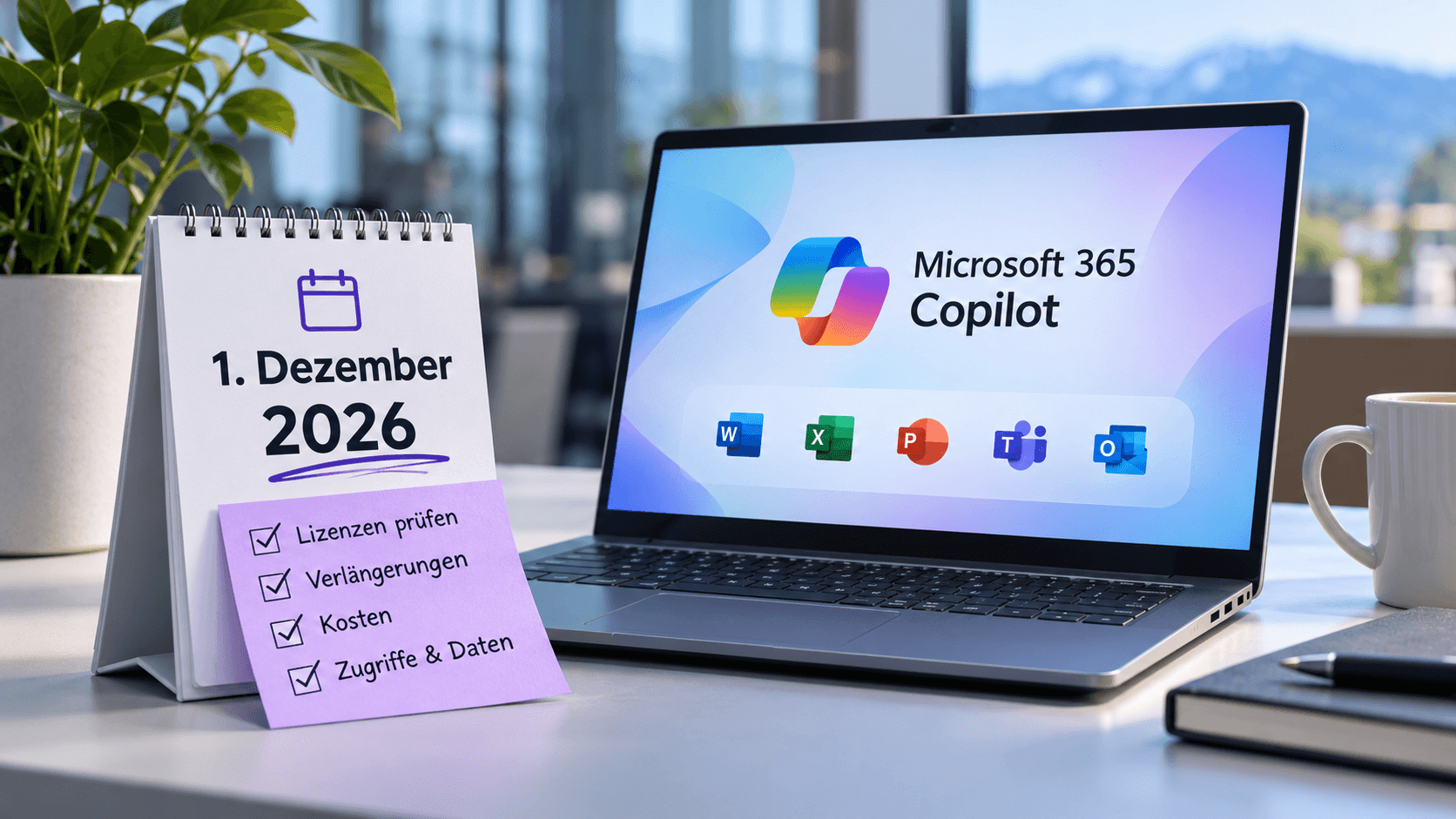
Microsoft 365 Copilot: What changes from December
By Jerome Scheidegger · CEO and Owner
From December 2026, the main change with Microsoft 365 Copilot is licensing. For companies, it is important to distinguish between new purchase models and existing subscriptions. Those already using Copilot do not have to automatically change their environment.
What changes with Microsoft 365 Copilot from 1 December 2026?
From 1 December 2026, Microsoft 365 Copilot and Microsoft 365 Copilot Business can be purchased without a prerequisite Microsoft 365 base subscription. At the same time, previous CSP offers with the addition «(add-on)» will reach end of sales for new purchases.
This primarily affects purchasing and license structure. The available Copilot features still depend on which Microsoft 365 apps and services a user is licensed for.
Microsoft is simultaneously expanding usage-based billing for additional AI services. So-called Copilot Credits become a shared consumption unit. This includes, among others, Copilot Cowork and other AI functions that are not billed solely via a fixed user license.
What happens to existing Copilot licenses?
Existing Copilot subscriptions will generally continue and do not have to be reassigned due to the change. The end of sales for previous add-on offers does not mean that existing licenses suddenly stop working on 1 December.
For IT managers, this distinction is important. Instead of swapping licenses hastily, the next renewal date should be checked first. Only then can a sensible decision be made about which model fits in the future.
Especially in larger environments, a stocktaking makes sense: Which employees really use Copilot? Which Microsoft 365 licenses are present? And which functions are actually needed?
What are Copilot Credits and what do they cost?
Copilot Credits are the consumption unit for various usage-dependent billed AI services from Microsoft. In the pay-as-you-go model, the list price is USD 0.01 per Credit. Converted at the USD/CHF rate from 16 November 2026 of around 0.839 CHF per USD, this corresponds to approximately CHF 0.0084 per Credit.
Thus, 5,000 Credits cost around CHF 42.-, 10,000 Credits around CHF 84.- and 15,000 Credits around CHF 126.-. The CHF values are conversions and not Swiss list prices published by Microsoft. Exchange rates and actual billing may vary.
How many credits are actually consumed depends heavily on the task. Multi-step jobs with multiple sources, files, and results require more credits than simple tasks. Therefore, companies should not just allocate a high budget for all users.
For the Copilot costs we have therefore created a separate overview.
Will Copilot Business be billed based on usage from December?
No. The initially announced standard usage-based billing for December has been postponed. According to current plans, this change should be introduced for new Microsoft 365 Copilot Business licenses via CSP between January and March 2027.
Usage-based services are already changing the cost logic today. Besides fixed user licenses, additional consumption costs can occur. Companies therefore need clear responsibilities and cost limits before broadly enabling such functions.
Microsoft provides functions for cost control in the Microsoft 365 Admin Center. Administrators can monitor consumption and define spending policies for supported services.
What should Swiss SMEs specifically check now?
Companies should review their existing Copilot licenses, renewal dates, and future areas of application. A technical migration solely because of 1 December is not required for existing subscriptions.
Five steps are sensible:
- Inventory existing Microsoft 365 and Copilot licenses.
- Check which employees actually need Copilot.
- Compare the existing add-on with the new offer at upcoming renewals.
- Consider users of Copilot Cowork and other consumption-dependent services separately.
- Set a budget and clear spending policies for Copilot Credits.
Technically available AI should not automatically be enabled for everyone. Cost control, permissions, and a clear purpose belong to operations from the start.
Does the change also affect security and data protection?
The licensing changes do not invalidate existing security, privacy, compliance, and administration controls.
For companies, another question remains crucial: Which data can Copilot access? A license alone does not answer this. Permissions in SharePoint, OneDrive, and Teams should be configured so that employees can only access information intended for them.
This becomes especially relevant when Copilot makes existing information more quickly findable. An introduction should therefore always also consider the permission structure and the handling of sensitive information.
What does the change mean overall?
The Copilot change from 1 December 2026 is mainly a change in the purchase and licensing model, not an obligation for immediate migration. At the same time, usage-based billing via Copilot Credits gains importance.
For SMEs, no rush is necessary. Check users, licenses, permissions, and future cost models together. This way, Copilot becomes a controlled part of the workplace and not another license with unexpected additional costs.